Learning objectives
- Look for the mathematical rule governing the shown pyramid
- Use known cells to calculate missing values
- Check answers and distinguish independent working from the Solve control
Mathematics — Addition and Algebraic Reasoning · Number-pyramid completion puzzle
Use the relationships among adjacent number-pyramid cells to practise forward addition and inverse reasoning.
Landscape activity · use fullscreen on a phone for larger controls
Learning focus: Use the relationships among adjacent number-pyramid cells to practise forward addition and inverse reasoning.
 Number Pattern: Guess My Age
 is a binary-selection activity that demonstrates how yes/no choices can identify a number.…
View Details
Play
Free Activity
 Christmas Gifts
 is a simple matching activity with a festive theme. Players connect similar gift icons to clear them an…
View Details
Play
Free Activity
 Sports Tournaments
 is a Physical Education quiz activity focused on tournament formats, competition structure, and spor…
View Details
Play
Free Activity
 Prismatic Dispersion: Spectral Simulation
Prismatic Dispersion is an optics simulation for exploring how light separates into colors through a prism. It uses phy…
View Details
Play
Free Activity
 Animal Idol: A Biology Game
Animal Idol is a biology quiz game that helps learners review animal and plant kingdom concepts. It supports science vo…
View Details
Play
Free Activity
 Noun Hunt: Identifying Nouns in Sentences
Noun Hunt helps learners identify nouns inside sentences. It supports grammar practice, reading attention, and sentence…
View Details
Play
★ Premium
 Number Pattern Name Game
 is a recreational mathematics activity based on digit operations and repeated patterns. It dem…
View Details
Access Info
Free Activity
 Human Fertilization Stages: Hindi Version
 is a biology learning activity that explains the fertilization process in a s…
View Details
Play
Free Activity
 Professions-N-Jobs
 helps learners identify common occupations and connect them with related pictures or roles. It suppo…
View Details
Play
Free Activity
 Math and Dice
 is an arithmetic practice game where dice rolls create math questions. Students answer equations using th…
View Details
Play
Free Activity
 Digital Place Value Abacus (DPVA)
Digital Place Value Abacus is a visual mathematics tool for learning the base-ten place value system. Students can ente…
View Details
Play
Free Activity
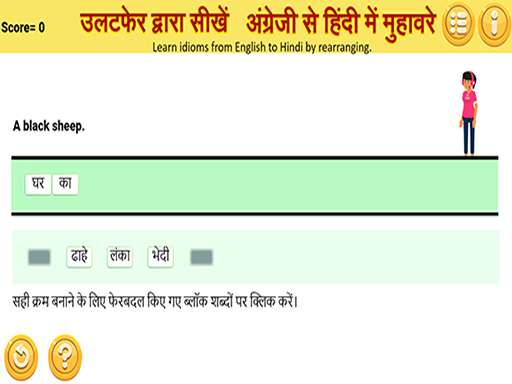 Shuffled Idioms
 is a Hindi language activity where learners arrange shuffled words to complete idioms and proverbs. It …
View Details
Play






💭 Comments