Learning objectives
- Count visible squares or other requested figures carefully
- Keep track of each stick moved, removed or added
- Verify that the final arrangement meets every part of the prompt
Mathematics — Spatial Reasoning · Matchstick shape-and-equation puzzles
Use stick rearrangements to think about geometric constraints, counting figures and preserving a requested number of moves.
Landscape activity · use fullscreen on a phone for larger controls
Learning focus: Use stick rearrangements to think about geometric constraints, counting figures and preserving a requested number of moves.
 Virtual Soroban: Japanese Abacus
Virtual Soroban is an interactive Japanese abacus activity for exploring bead values and number representation. Student…
View Details
Play
Free Activity
 Professions-N-Jobs
 helps learners identify common occupations and connect them with related pictures or roles. It suppo…
View Details
Play
Free Activity
 Word Sort: Professions and Jobs
 is an English vocabulary activity that helps children recognize occupation names. Learn…
View Details
Play
Free Activity
 Yes/No Communication Practice
 is a visual prompt activity for learners who are practising simple yes and no responses. …
View Details
Play
Free Activity
 Photoelectric Effect Simulation
 is a physics learning tool for exploring how light can eject electrons from a material.…
View Details
Play
Free Activity
 Sub-Down-Ladder
 is a subtraction-focused mathematics game that turns number practice into a path-finding challenge. Lea…
View Details
Play
Free Activity
 Buffon's Needle Probability Lab
 is a geometry and probability activity based on the classic needle-dropping experiment.…
View Details
Play
Free Activity
 Prismatic Dispersion: Spectral Simulation
Prismatic Dispersion is an optics simulation for exploring how light separates into colors through a prism. It uses phy…
View Details
Play
Free Activity
 Pendulum Lab 1: Real-Time Physics Simulation
Pendulum Lab 1 is a real-time simulation for studying pendulum motion. Students can observe oscillation, change variabl…
View Details
Play
Free Activity
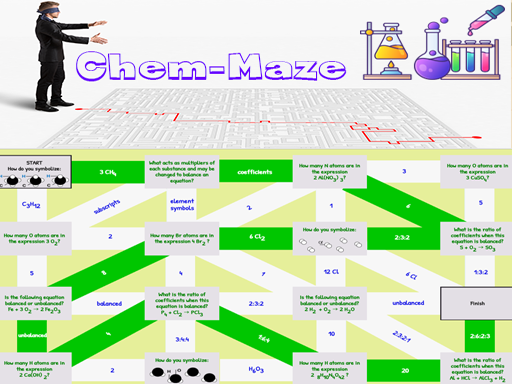 Chem-Maze: Balancing Equations Path
Chem-Maze is a chemistry logic activity that connects maze-style choices with chemical equation balancing. Students fol…
View Details
Play
Free Activity
 Hare and Tortoise: Number Sequencing
 is an early mathematics activity inspired by a familiar story theme. Children arra…
View Details
Play
Free Activity
 X-MATHS
 is an addition puzzle game where learners place answers to complete diagonal sums. It supports arithmetic fluen…
View Details
Play







💭 Comments