Mathematics · Grades 6–9 · Interactive learning companion

Heron's Formula Triangle Simulator

Use three side lengths to calculate a triangle’s semi-perimeter and area, then connect the calculation with a changing geometric shape.

Landscape activity · use fullscreen on a phone for larger controls

↗ New Window

📝 Description

Heron's Formula Triangle Simulator helps students explore triangle area using side lengths. Learners adjust or drag triangle values, calculate semi-perimeter, and connect the formula with geometric area. It supports middle-school geometry and visual mathematics practice.

📋 Instructions

Adjust the triangle sides and observe the calculated values. Use the activity to connect side lengths, semi-perimeter, and area using Heron's formula.

🎓 Learning Guide: Heron's Formula Triangle Simulator

Learning focus: Use three side lengths to calculate a triangle’s semi-perimeter and area, then connect the calculation with a changing geometric shape.

Mathematics Grades 6–9 Interactive learning companion

Learning objectives

  • Measure or identify the three side lengths a, b and c of a triangle.
  • Calculate the semi-perimeter s = (a + b + c)/2 and apply Heron’s formula.
  • Check whether three proposed lengths can form a non-degenerate triangle before calculating its area.
Concepts and principles

  • Heron’s formula is A = √[s(s − a)(s − b)(s − c)], where s = (a + b + c)/2.
  • The triangle inequality requires each pair of side lengths to have a sum greater than the third length.
  • Heron’s formula uses side lengths only. It gives the same area as A = ½bh when the base b and perpendicular height h are known.

Try this investigation

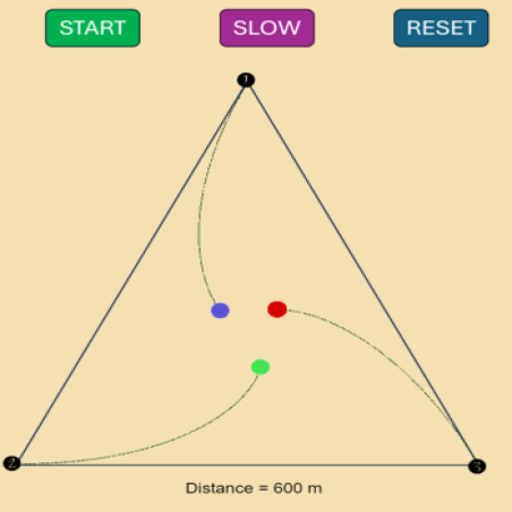
  1. Drag the vertices to create a scalene triangle and record its three displayed side lengths.
  2. Calculate s and then the four factors s, s − a, s − b and s − c before taking the square root.
  3. Compare your result with the area displayed by the simulation, allowing for rounding.
  4. Move one vertex so the triangle becomes flatter. Record what happens to the area as two sides approach a straight line.

Expected observations and explanations

  • Different-looking triangles can have similar perimeters but different areas because their perpendicular heights differ.
  • As a valid triangle becomes nearly collinear, one Heron factor approaches zero and the area approaches zero.
  • If a + b = c exactly, the points form a straight segment rather than a triangle, and Heron’s expression gives zero area.

Assessment questions and answers

Find the area of a triangle with side lengths 3, 4 and 5 units.
Answer: s = (3 + 4 + 5)/2 = 6, so A = √[6 × 3 × 2 × 1] = √36 = 6 square units.
Can lengths 2, 3 and 5 units form a triangle?
Answer: No. Because 2 + 3 = 5 rather than being greater than 5, the shape is degenerate and has zero area.

💭 Comments

🎮 More Mathematics Activities