Learning objectives
- Explain selected astronomy terms in clear language
- Distinguish natural and artificial space objects
- Recognise when a term names an inferred phenomenon rather than a directly identified substance
Astronomy — Scientific Vocabulary · Interactive space glossary
Read astronomy terms as precise scientific definitions and distinguish observed objects from hypotheses about the distant future.
Portrait activity · keep the device upright for the intended layout
Learning focus: Read astronomy terms as precise scientific definitions and distinguish observed objects from hypotheses about the distant future.
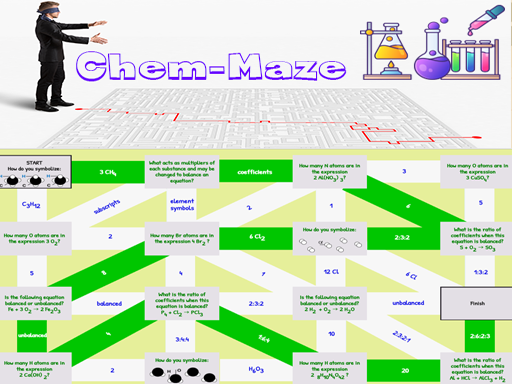 Chem-Maze: Balancing Equations Path
Chem-Maze is a chemistry logic activity that connects maze-style choices with chemical equation balancing. Students fol…
View Details
Play
Free Activity
 Pool Racer: Question Race Activity
Pool Racer is a question-based racing activity that connects race outcomes with learning challenges. Students answer qu…
View Details
Play
Free Activity
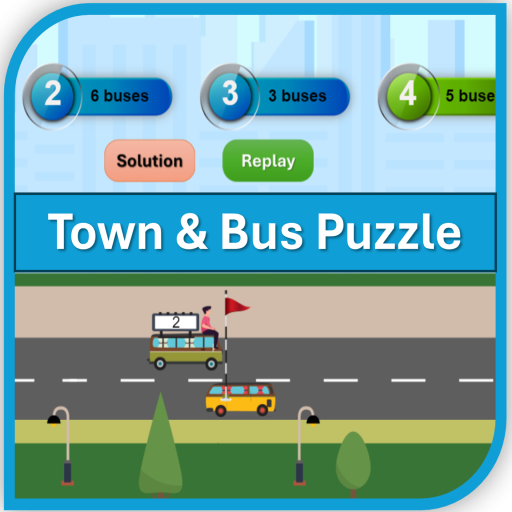 Town and Bus Puzzle Simulation
 is a math and physics reasoning activity about periodic motion and meeting patterns. Stu…
View Details
Play
Free Activity
 Physics Balancer 2: Torque Balance Simulation
Physics Balancer 2 is a torque and lever-balance simulation. Students place masses at different positions and observe h…
View Details
Play
Free Activity
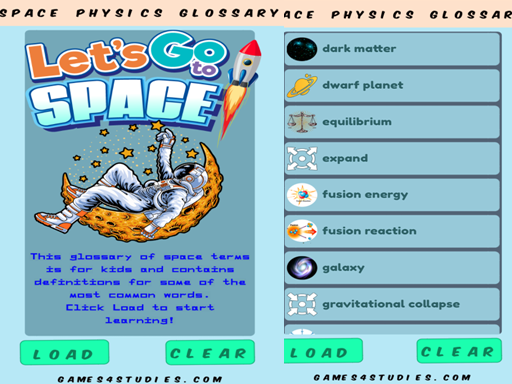 Glossary of Space Terms
 is a simple space vocabulary activity for students. It introduces common astronomy words and sh…
View Details
Play
Free Activity
 Word Sort: Professions and Jobs
 is an English vocabulary activity that helps children recognize occupation names. Learn…
View Details
Play
Free Activity
 The Story Teller 1
 is an interactive story activity inspired by classroom reading. It combines simple storytelling, vis…
View Details
Play
Free Activity
 Ramanujan Magic Square
 is a recreational mathematics activity inspired by number patterns and magic squares. Students c…
View Details
Play
Free Activity
 Dinosaur Flashcards
 is an educational visual activity featuring well-known dinosaurs. Students explore names, illustrat…
View Details
Play
Free Activity
 Pendulum Lab 1: Real-Time Physics Simulation
Pendulum Lab 1 is a real-time simulation for studying pendulum motion. Students can observe oscillation, change variabl…
View Details
Play
Free Activity
 Angle-Snipper
 is an interactive mathematics game that helps learners recognize angles, compare directions, and build vi…
View Details
Play
Free Activity
 Opposites and Antonyms
 is an illustrated English activity that helps learners understand opposite words through example…
View Details
Play






💭 Comments