A festive card battle with an unexpected mathematics lesson
A familiar plate of Indian mithai can prompt stories about celebrations and family traditions. It can also become a playful exercise in number comparison. Diwali Mithai Card Battle — Play, Learn & Celebrate is an original NANDAX game on Games4Studies that brings both together without interrupting the fun with compulsory quizzes.
The game includes 20 illustrated sweets, including Jalebi, Gulab Jamun, Soan Papdi, Rasgulla, Mysore Pak
Play Diwali Mithai Card Battle now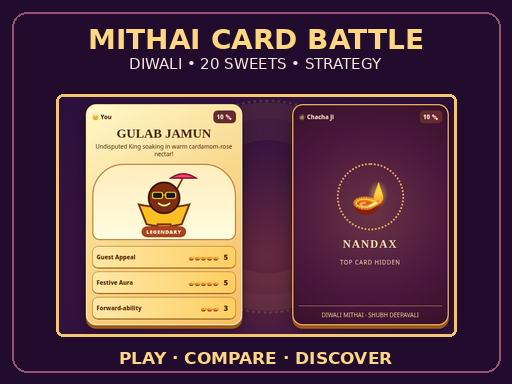 re Pak and Kaju Katli. Each card has three deliberately fictional ratings: Guest Appeal, Festive Aura and Forward-ability, on a 1-to-5 scale. These are invented game values, not nutritional data, factual food rankings or judgments about the importance of regional traditions.
Play the game: https://www.games4studies.com/game/diwali-mithai-card-battle-play-learn-celebrate
How the battle works
Choose Quick Battle or a longer Classic game and compete against one, two or three computer opponents. In each round you select a property from your current card and compare its number with the opponents' values. The highest chosen rating wins. In a tie, contested cards move to the Center Thal until a later round resolves them.
This provides a simple strategic question: should you always select the largest number on your own card, even when you cannot see what the opponents have? A player must make a choice under uncertainty, observe the outcome and try again.
The maths hidden in the game
Number comparison: decide whether 4 is greater than 2, whether 1 is less than 3 or whether two scores are equal.
Difference: a 4–2 victory margin means two game points, calculated as 4 minus 2.
Equality: a 3–3 tie demonstrates an equal result and changes how later cards are resolved.
Strategy: select an attribute without pretending to know the opponent's hidden value.
Explanation: tell a classmate why you chose a property, instead of merely announcing who won.
These are examples of the game's mathematical ideas, not factual ratings of specific sweets. Younger learners can practise comparing one-digit values; older learners can discuss decision-making with incomplete information.
Food traditions without ranking cultures
India's Diwali celebrations involve diverse regional and family customs. Familiar desserts offer a friendly way to compare names, ingredients, preparation techniques and textures. The game's optional Discover panel presents small Maths, Science and Culture topics that can start a conversation without interrupting the battle.
Ask: Which sweet do you know? Which unfamiliar one would you like to learn about? Could differences in ingredients or preparation help explain texture? The focus should be curiosity and cultural respect, not deciding that a particular region's sweet is objectively best.
A ten-minute classroom or family activity
Minutes 1–2: Observe three cards and identify their 1–5 ratings. Explain that scores are fictional.
Minutes 3–7: Play a Quick Battle. Occasionally invite a learner to name the chosen property, compare two numbers and calculate a winning margin or describe a tie.
Minutes 8–10: Reflect. Did picking the highest personal value guarantee a win? Which strategy did you change? Which sweet would you like to research from a reliable source?
For a larger group, one learner can control the game while classmates suggest decisions. Let cultural sharing remain voluntary. No personal information or tests are required.
Useful beyond Diwali
The festive artwork celebrates food traditions, but number comparison is relevant year-round. Used thoughtfully, the game is a compact maths warm-up and a conversation about choices, culture and uncertainty. It is not a substitute for a curriculum lesson or scientific analysis of food.
Play Diwali Mithai Card Battle: https://www.games4studies.com/game/diwali-mithai-card-battle-play-learn-celebrate
Further cultural reading: National Museum of Asian Art — https://asia.si.edu/whats-on/events/celebrations/diwali/
Created by SANJEEV NANDA | NANDAX — Games4Studies. All card ratings are fictional.
Article comments
No comments yet. Be the first authorized user to add a learning note.