A festival message, explored through play
Dussehra, also known in many contexts as Vijayadashami, carries stories about the triumph of good over evil. Regional traditions include celebrations associated with Rama and Ravana, and with Durga. Those diverse observances can lead to thoughtful discussion about the everyday choices people make.
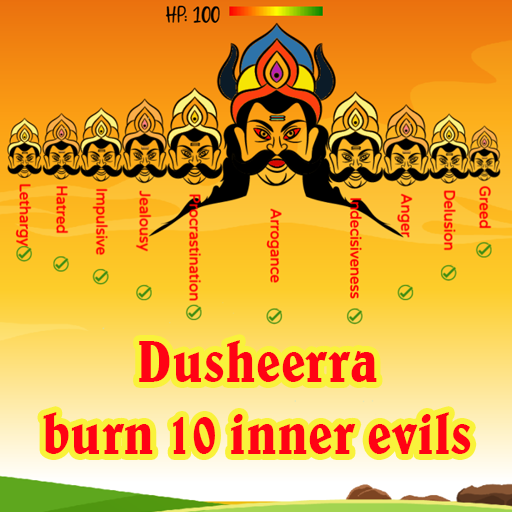
Dussehra Values Challenge is a short browser game created by NANDAX on Games4Studies. The published game uses a festive arcade-style challenge emphasizing attention, timing and quick responses. Players follow the controls, aim for accuracy and collect points. The game is a starting point for cultural reflection, not a formal moral assessment.
Play the game: https://www.games4studies.com/game/dusshera-burn-10-inner-evils
From symbolic victory to ordinary choices
Ten-headed Ravana imagery appears in familiar Dussehra stories and visual traditions. Some modern learning activities use this symbolism to discuss harmful habits and constructive alternatives. There is no single universally agreed list of ten inner evils; the pairs below are optional contemporary classroom reflections, not authoritative religious teachings or claims about ten specific built-in game mechanics.
Anger can be met with patience and a short pause.
Jealousy can encourage gratitude rather than constant comparison.
Greed can lead to a discussion of fairness and sharing.
Arrogance can be challenged by listening to different perspectives.
Dishonesty can be replaced by truthfulness.
Carelessness can become attention and responsibility.
Unkindness can become empathy.
Resentment can become a sincere attempt to repair a relationship.
Impulsiveness can become self-control.
Indifference can become a helpful action.
Learners can suggest different examples and explain why they chose them. The goal is reflection, not labelling classmates or cultures as good or evil.
What the game actually practices
The challenge invites players to focus, respond with appropriate timing and aim for greater accuracy. It also offers a starting question: Did a hurried reaction help or hurt? What changed when you tried again? When is pausing more useful than moving faster?
Completing a target or timing game does not itself prove improved ethical behaviour. A game's value in this context comes from the discussion that follows, rather than assuming measured changes in character.
A ten-minute cultural-learning activity
Begin (2 minutes): Invite students to share stories or festival practices they associate with Dussehra. Respect different regional, family and individual traditions and allow learners to opt out of sharing.
Play (5 minutes): Run a short game session and notice what changes when players slow down, practise or revise their approach.
Reflect (3 minutes): Connect one ordinary difficulty to a constructive choice: waiting for a turn, reconsidering a harsh message, sharing classroom supplies or admitting a mistake. Discuss behaviour rather than judging people.
A parent or teacher might ask: What did you do differently on the second try? What can a small victory over a difficult habit look like?
Cultural understanding for a diverse classroom
Festivals are opportunities to learn about traditions without requiring every learner to celebrate them or treating one regional account as universal. The game is suitable for a quick classroom warm-up, a discussion of symbolism or simple timing practice; it is not a complete history of Dussehra.
Try Dussehra Values Challenge: https://www.games4studies.com/game/dusshera-burn-10-inner-evils
Further cultural reading: Maharashtra Tourism — Dussehra https://maharashtratourism.gov.in/festivals/dussehra/
Created by SANJEEV NANDA | NANDAX — Games4Studies. The ten-choice reflections are optional teacher material, not claims about built-in gameplay or canonical religious interpretations.
Article comments
No comments yet. Be the first authorized user to add a learning note.