When a trusted friend forwards an unverified message
A forwarded message can feel persuasive because it came from somebody we know. Yet familiarity with the sender does not establish the truth of the claim. Verify It! — Guardians of the Digital Community turns that familiar digital dilemma into an interactive English–Hindi game.
You become administrator of the fictional Shanti Nagar Family & Neighbours group. Across eight casPlay Verify It! now
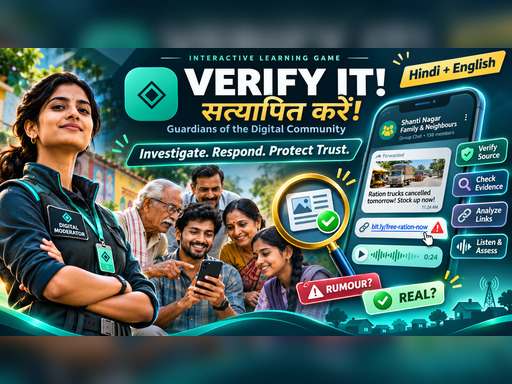 es in three acts, neighbours circulate information that may be misleading, risky, confusing or genuinely useful. Your job is not to dismiss everything. It is to check available evidence, protect the group and respond without embarrassing people who shared something in good faith.
Play the game: https://www.games4studies.com/game/verify-it-guardians-of-the-digital-community
From investigation to conversation
The Evidence Lab provides four kinds of investigations: Visual Context, Voice & Origin, Case Registry, and Link & Wording. Players inspect simulated clues, pin useful evidence, choose among four interventions and edit a respectful message before sending it to the group. Neighbours reply in the chat. Trust, Harmony and Rumour Risk indicators reflect choices within the game.
A factual correction can still be harsh. A kind-sounding response can still fail to stop a harmful rumour. Good digital citizenship asks us to think about both evidence and other people.
Five real-world habits
1. Pause before forwarding. A message designed to trigger fear or urgency deserves additional scrutiny.
2. Identify the original source. A friend's screenshot may be several steps removed from the actual publisher.
3. Check dates and full web addresses. Open trusted official sources independently rather than trusting an unsolicited link.
4. Seek independent corroboration. Several copies of the same forward are not independent confirmation.
5. Correct kindly. Say what remains uncertain, where people can check and what they can safely do while checking.
These are learning habits rather than guarantees of authenticity. For immediate dangers, use current official alerts and emergency services as needed.
A ten-minute classroom activity
Ask pairs of students to play a case and examine two different clue types. Each pair then drafts an administrator's response in three parts: what is uncertain, what should be checked, and what safe action is appropriate meanwhile. Compare responses after the fictional neighbours react. Which gives a useful next step? Which could create needless alarm or shame?
Include a genuine notice in the discussion to show that thoughtful verification does not mean distrusting every announcement.
Educational alignment, with clear limits
UNESCO's Media and Information Literacy curriculum addresses evaluating information, misinformation, digital citizenship and responsible participation. Verify It! independently explores related themes through a fictional narrative; it is not endorsed, accredited or certified by UNESCO, Games for Change India or government agencies.
Its Evidence Lab does not perform live reverse-image search, government record verification or AI voice-forensic detection. The Community Digital Guardian appreciation certificate is an in-game award, not proof of professional competence. Trust, Harmony and Rumour Risk are fictional game metrics, not measured real-world impact.
Try the eight-case experience, then discuss how a similar real claim could be checked responsibly.
Play Verify It!: https://www.games4studies.com/game/verify-it-guardians-of-the-digital-community
Reference: UNESCO Media and Information Literacy Curriculum — https://www.unesco.org/mil4teachers/en/curriculum
Created by SANJEEV NANDA | NANDAX — Games4Studies.
Article comments
No comments yet. Be the first authorized user to add a learning note.